|
Stainless Steel vs. Carbon Steel
Central Boiler outdoor furnaces are manufactured using heavy gauge carbon steel. Carbon steel is the material of choice based on its ability to withstand the stress, corrosive environment, and high temperatures that are exerted on your firebox during operation.
302, 304, 304L and 305 stainless steel alloys simply fall short of what it takes to withstand the stresses and corrosive environment that outdoor wood furnace metals are exposed to while they are in use.
Stress Corrosion Cracking

Stress Corrosion Cracking (SCC) is defined as: the failure induced by the combined influences of tensile stress and a corrosive environment. Combinations of the following conditions can cause SCC: (1) presence of halide ions (generally chloride), (2) residual tensile stresses, and (3) temperatures in excess of about 120°F (49°C).
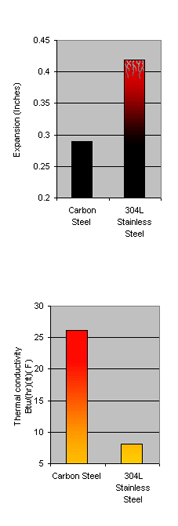
Left are two graphs that illustrate how two outdoor wood furnace metals (Carbon Steel and 304L Stainless Steel) react to the high temperatures exerted on them during operation.
Thermal Expansion
Thermal expansion is the expansion in metal resulting from an increase in temperature. The greater the expansion rate, the greater the chance of SCC (Stress Corrosion Cracking) to occur in the metal.304L Stainless Steel has nearly double the expansion that Carbon Steel has.
The graph (on the left) reflects the expansion amount on a 4’x 4′ sheet of metal.
References: Mechanics of Materials, Beer and Johnston
Material Property Data, MatWeb
Thermal Conductivity
Heat is normally conducted by atoms literally bumping into each other. Metal electrons add to this flow of heat, which is why metals tend to be good conductors of heat. The measure of how good a material is at conducting heat is known as its thermal conductivity. Thermal conductivity is defined as the rate at which heat flows through material. A firebox material with higher thermal conductivity will boost the efficiency of your outdoor wood furnace by transferring more Btu’s into the water jacket, instead of out your chimney.
References: Standard Handbook for Mechanical Engineers, Baumeister & Marks National Physical Laboratory, Internet
Austenitic Stainless Steel
304L Stainless Steel Type 302, 304, 304L and 305 alloys are the most susceptible of all the Austenitic Stainless Steels to SCC. References: Technical Data Blue Sheet, Allegheny Ludlum Chemical Engineering, Oct 18, 1982
References: Technical Data Blue Sheet, Allegheny Ludlum
Chemical Engineering, Oct 18, 1982
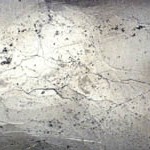 This is actual Low Carbon Austenitic Stainless Steel cut out of a wood furnace that failed due to Stress Corrosion Cracking. This is actual Low Carbon Austenitic Stainless Steel cut out of a wood furnace that failed due to Stress Corrosion Cracking.
CLICK HERE to inspect the Low Carbon Austenitic
|